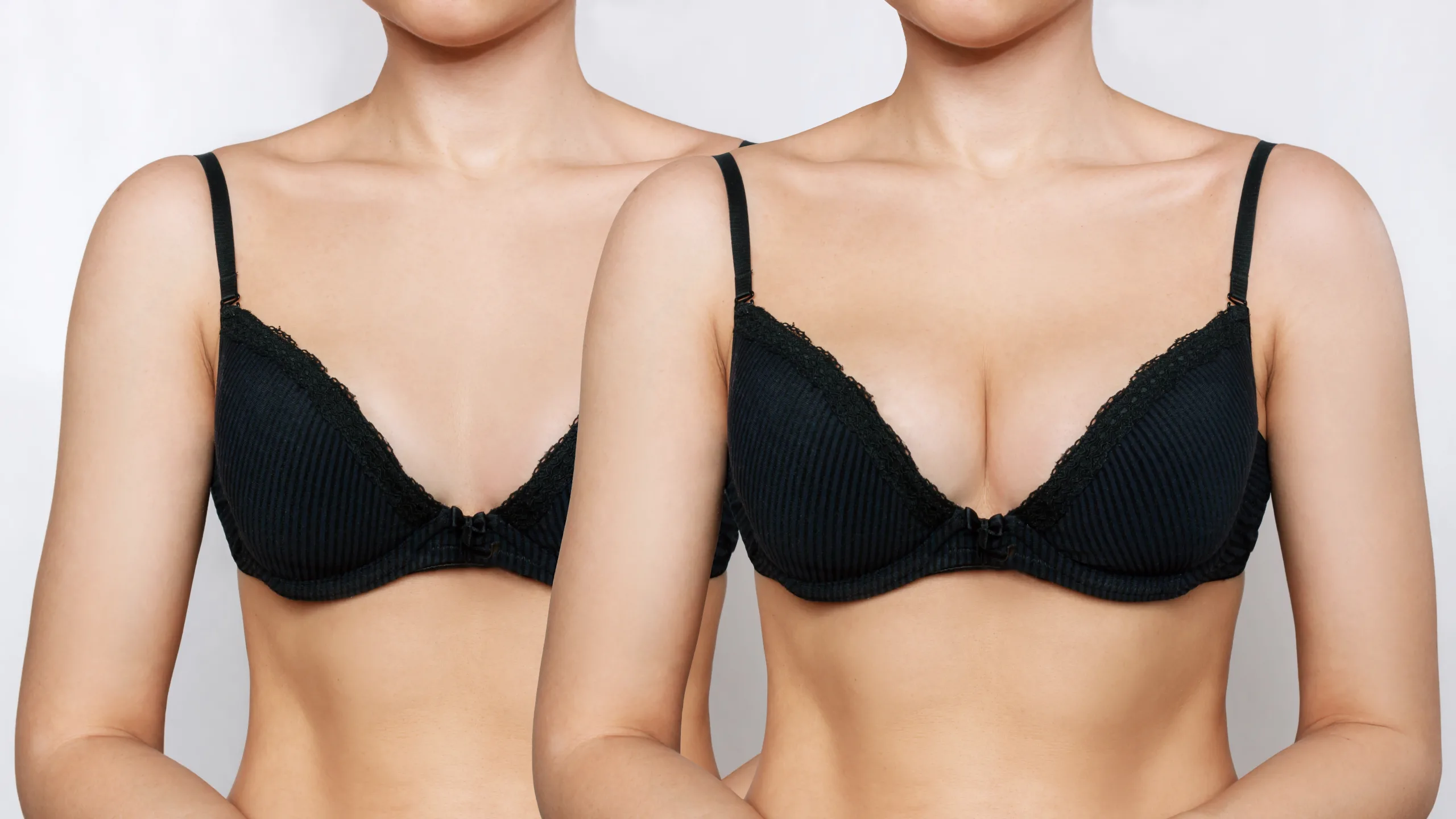
Breast

Enlargement with implants

Breast augmentation with implants is a well-established and trusted procedure for women seeking to enhance breast volume, improve symmetry, and refine contour — creating results that feel balanced, natural, and in harmony with the body. It can restore fullness after pregnancy or weight loss, or offer gentle enhancement for those wishing to refine their silhouette.

During consultation, I use advanced simulation technology to help you visualise potential outcomes and choose the most suitable implant size, shape, and profile for your body. This allows us to plan your surgery with precision and confidence, ensuring the result feels authentic and beautifully proportionate.

In the procedure itself, silicone implants are placed either beneath the breast tissue (subglandular) or partly under the chest muscle (dual-plane). The choice of implant type, size, and placement is guided by your anatomy, lifestyle, and aesthetic goals.

Compared with fat transfer alone, implants offer unique advantages:

  • Precision – predictable control over volume and projection.
  • Immediate results – visible fullness straight after surgery.
  • Personalisation – wide variety of shapes and profiles for a bespoke fit.
  • Efficiency – avoids donor-site liposuction, allowing faster recovery.

The aim is to achieve a naturally enhanced shape that complements your proportions — never overdone, always beautifully your own.

Procedure duration

1 hour


Anaesthesia

General (Day case)


Pain/discomfort

Moderate for 1–2 weeks; longer if dual-plane placement


Wound healing

Approx. 2–3 weeks


Surgical bra

Worn continuously for 3 months


Return to work

From 1-2 weeks


Sports & exercise

Resume gradually after 8 weeks


Final results

3–6 months – as swelling subsides and tissues soften


Scar maturation

6–12 months – scars fade and refine in texture

Arbrea

Final Results

Final results become apparent after 3–6 months, once swelling subsides and the breasts settle into their natural position. Scars continue to refine over the following 6–12 months, leaving soft, well-healed lines.

The result is a naturally enhanced, beautifully proportioned silhouette — one that feels balanced, confident, and truly your own.

  • 1. Who it is for?

    Breast augmentation with implants may be suitable if you:

    • Wish to enhance naturally smaller breasts or balance asymmetry.
    • Desire to restore breast volume lost after pregnancy, breastfeeding, or weight loss.
    • Seek improved contour or upper fullness.
    • Are in good general health and have realistic expectations of results.
  • 2. What are the risks and considerations?

    All surgical procedures carry risks, and these will be discussed with you in detail at your consultation. In experienced hands, complications are uncommon, but it is important to be aware of potential issues, including:

    Common risks:

    • Temporary swelling, bruising, or discomfort.
    • Minor asymmetry or changes in nipple sensation.
    • Implant-related issues such as capsular contracture, implant malposition, or rupture.
    • Bleeding, infection, or delayed wound healing (rare).
    • Scarring — generally fine and concealed in the breast crease.

    Rarer risks:

    • BIA-ALCL (Breast Implant-Associated Anaplastic Large Cell Lymphoma) — a rare immune system–related cancer linked to some textured implants.
    • BIA-SCC (Breast Implant–Associated Squamous Cell Carcinoma) — an extremely rare tumour reported in isolated cases.
    • BII (Breast Implant Illness) — a non-specific syndrome described by some patients, involving fatigue, joint pain, or brain fog; its cause is not fully understood.

    These conditions are exceptionally uncommon, and ongoing research continues to ensure patient safety. Only MHRA-approved implants are used, and all implant details are recorded in the UK Breast and Cosmetic Implant Registry for traceability and transparency.

  • 3. What will recovery feel like in the first few days?

    It’s normal to experience tightness across the chest, a feeling of pressure, and some swelling. Most patients describe the discomfort as similar to intense muscle soreness, which settles quickly with simple pain relief and supportive garments. You’ll be encouraged to walk around the house the same day to improve circulation.

  • 4. When can I lift my arms or do everyday tasks?

    Gentle arm movements are encouraged immediately, but overhead movements and heavier tasks should be avoided for 2 weeks. You can gradually resume light daily activities as comfort allows, but anything involving pushing, pulling, or lifting should be kept to a minimum until cleared at follow-up.

  • 5. How long does swelling take to settle?

    Most swelling improves significantly within 4 weeks, but the implants continue to soften and settle into their final position over 12 weeks. Submuscular or dual plane implants may take a little longer to fully relax. The final result can be appreciated at 6 months.

  • 6. When can I return to work or training?
    • For desk-based work, most patients are able to return after 1–2 weeks, provided they are comfortable and able to move freely.
    • For more physically demanding roles—especially those involving lifting, pushing or repetitive upper-body movements—the typical return timeframe is 2–4 weeks, depending on the job demands.

    If you like, I can draft a version of this section specifically for athletes (by sport type) that you can include in your website.

  • 7. Will I need lymphatic massage or special aftercare?

    Most patients recover well with supportive bras, simple pain relief, and gradual return to movement. If swelling or tightness persists, targeted massage or physiotherapy may be recommended on an individual basis.

  • 8. When can I drive or fly?

    You can drive once you feel able to comfortably and safely control the vehicle in all directions and perform an emergency stop. For most patients, this is around 2 weeks after surgery.

    Flying is generally avoided for the first 4 weeks because of the effects of general anaesthetic, changes in cabin pressure, and the increased risk of swelling or discomfort during recovery. It’s best to discuss any planned travel with me during your consultation so we can tailor advice to your procedure and healing.

  • 9. When can I exercise again?
    • Gentle walking: immediately
    • Light cardio: from 3 weeks
    • Lower-body training: from 4 weeks if it doesn’t strain your chest
    • Upper-body workouts: usually after 8 weeks
    • High-impact or weight training: after 8–12 weeks, depending on the placement and your individual healing.

    Your aftercare plan will be tailored to your activity level and implant type.

  • 10. What changes can I expect as the implants settle?

    In the first few weeks the breasts may sit higher and feel firm. As swelling settles and the tissues relax, the implants drop into a more natural position and the shape becomes softer. This process—often called the “drop and fluff”—can take 12 weeks or sometimes longer, depending on implant placement and your natural tissue.

  • 11. How will my scars heal?

    Your scars will be placed on your breast crease. They usually appear pink for the first few weeks before gradually fading over several months. You will be given detailed scar-care advice, including silicone therapy, sun protection, and massage once the incision has fully healed.

Guidance for Athletes

Athletes often have unique recovery needs due to the intensity and frequency of their training. Returning too quickly can affect healing, implant position, and long-term results. The timeline below provides general guidance, but your plan will always be personalised to your sport and training level.

Athletes FAQs

  • 1. When can I return to training?

    First 2 weeks

    • Focus on rest, walking, and gentle mobility only.
    • Avoid raising your heart rate significantly.
    • No upper-body work, weights, swimming, or impact activity.
    • Wear a supportive post-operative bra day and night.

    Weeks 2–4

    • Light lower-body training (e.g. stationary bike, gentle treadmill walk) is often possible if it does not cause chest movement or discomfort.
    • No arm weights, rowing, chest activation, or plyometrics.
    • Continue full-time supportive bra use.

    Weeks 4–6

    • Gradual progression of lower-body training.
    • Light aerobic work may be introduced.
    • Still avoid workouts that activate pectoral muscles or cause breast bouncing (e.g. running, HIIT, CrossFit).

    Weeks 6–12

    • Running and controlled impact activity may be introduced slowly from around 6 weeks, depending on comfort and implant placement.
    • Upper-body work (press-ups, chest press, pull-ups, swimming, climbing, pole fitness) should generally wait until 12 weeks.
    • A high-support sports bra is essential for all training.

    Professional and elite athletes

    • A full return to pre-surgery training intensity usually takes 12 weeks.
    • Sport-specific movements, strength conditioning, and overhead work should be phased back in with physiotherapy or coaching oversight.
    • High-impact chest loading (e.g. martial arts, gymnastics, competitive CrossFit, weightlifting) often requires the full 3 months before unrestricted activity.
  • 2. What should athletes wear during recovery?
    • A post-operative support bra for 12 weeks, followed by a high-support sports bra for all activity thereafter.
    • Avoid underwired bras until fully healed.
    • Many athletes transition to dual-support (compression + encapsulation sports bra) when resuming higher-impact training.

    Key points for athletic recovery

    • Protect the repair: avoid pec activation early on.
    • Do not rush upper-body training, even if you feel well.
    • Impact and high-load training require a slower return.
    • Supportive bras are essential for maintaining implant position.
    • Rehabilitation should be tailored to your sport, training cycle, and competition demands.
Doctify - Great Patient Experience

Schedule a consultation

Contact us